
Introduction
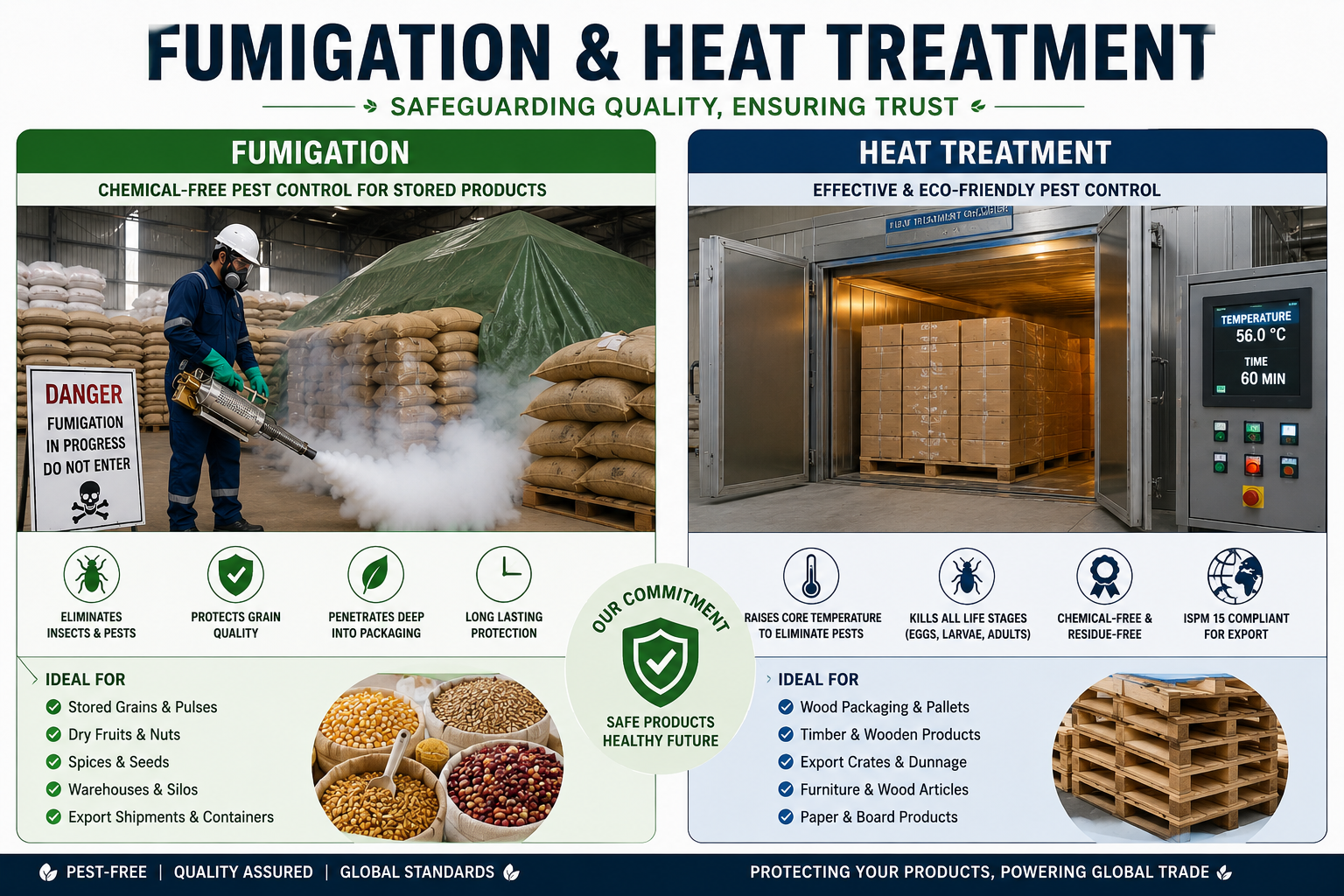
Protecting agricultural commodities, stored grains, wooden packaging materials, and warehouses from pests is essential for maintaining product quality and preventing economic losses. Two of the most widely used pest control methods are Fumigation and Heat Treatment.
Both techniques are highly effective in eliminating insects, larvae, eggs, and other harmful pests. However, their working principles, applications, advantages, and limitations differ significantly. Understanding these differences helps farmers, warehouse operators, exporters, and logistics companies choose the most suitable treatment method.
What is Fumigation?
Fumigation is a pest control process that uses specially approved gases, known as fumigants, to eliminate pests from enclosed spaces such as grain warehouses, silos, shipping containers, and storage facilities.
The fumigant gas penetrates deep into commodities and reaches hidden pests that are difficult to control through conventional methods.
Common Fumigants
- Phosphine
- Sulfuryl Fluoride
- Controlled Atmosphere Gases
Main Purpose
- Eliminate stored grain pests
- Protect agricultural commodities
- Meet export quarantine requirements
- Reduce post-harvest losses
What is Heat Treatment?
Heat Treatment is a chemical-free pest control process that uses controlled high temperatures to kill insects, larvae, eggs, fungi, and microorganisms.
The treatment raises the temperature of the material to a specific level and maintains it for a predetermined period to ensure complete pest eradication.
Main Purpose
- Eliminate pests without chemicals
- Treat wooden packaging materials
- Meet international export standards
- Prevent pest infestations during transportation
How Fumigation Works: Step-by-Step Process
Step 1: Inspection
Experts inspect the commodity or storage area to identify:
- Pest species
- Infestation level
- Storage conditions
Step 2: Sealing
The area is sealed using gas-proof sheets or airtight structures.
Step 3: Fumigant Application
The selected fumigant is introduced into the sealed environment.
Step 4: Exposure Period
The gas remains inside the structure for a specified duration, allowing it to penetrate deeply and eliminate pests.
Step 5: Aeration
The area is ventilated to remove residual gases.
Step 6: Safety Clearance
Gas monitoring ensures the treated area is safe for re-entry.
How Heat Treatment Works: Step-by-Step Process
Step 1: Preparation
Products are placed inside a heat treatment chamber or specialized facility.
Step 2: Temperature Increase
The temperature is gradually raised to the required level.
Step 3: Holding Period
The temperature is maintained long enough to kill pests at all life stages.
Step 4: Monitoring
Sensors continuously monitor temperature levels.
Step 5: Cooling
Products are allowed to cool naturally.
Step 6: Certification
The treated material receives certification if required for export.
Fumigation vs Heat Treatment: Detailed Comparison
| Feature | Fumigation | Heat Treatment |
|---|---|---|
| Method | Gas-based pest control | Temperature-based pest control |
| Chemicals | Uses fumigants | Chemical-free |
| Penetration | Excellent penetration | Heat penetration required |
| Residue | Requires aeration | No residue |
| Environmental Impact | Depends on fumigant | Environmentally friendly |
| Application | Grains, warehouses, containers | Timber, pallets, packaging |
| Export Compliance | Widely accepted | Required for many wooden products |
| Cost | Generally economical for bulk storage | Higher equipment costs |
Benefits of Fumigation
1. Deep Penetration
Gas reaches hidden pest locations.
2. Complete Pest Control
Kills eggs, larvae, pupae, and adults.
3. Protects Stored Grains
Reduces post-harvest losses.
4. Suitable for Large Storage Facilities
Ideal for silos and warehouses.
5. Supports Export Trade
Meets international phytosanitary requirements.
Benefits of Heat Treatment
1. Chemical-Free Process
No pesticide residues remain.
2. Eco-Friendly
Minimal environmental impact.
3. Safe for Wooden Products
Maintains compliance with export regulations.
4. Fast Treatment
Usually completed within a few hours.
5. Sustainable Solution
Supports green pest management practices.
Common Applications of Fumigation
- Grain Silos
- Rice Mills
- Wheat Storage Facilities
- Warehouses
- Food Processing Plants
- Shipping Containers
- Agricultural Commodities
- Export Cargo
Common Applications of Heat Treatment
- Wooden Pallets
- Timber Products
- Export Crates
- Wooden Packaging Materials
- Furniture Components
- Lumber Industry
Which Method Should You Choose?
Choose Fumigation If:
1. You store grains, pulses, seeds, or spices.
2. You need deep pest penetration.
3. You manage warehouses or silos.
4. You require large-scale pest control.
Choose Heat Treatment If:
1. You deal with wooden pallets or timber.
2. You want a chemical-free solution.
3. You need ISPM-15 compliance for export.
4. Environmental sustainability is a priority.
Importance in Agriculture
Both fumigation and heat treatment contribute significantly to modern agriculture by:
- Reducing storage losses
- Maintaining crop quality
- Preventing pest infestations
- Improving food security
- Supporting international trade
- Increasing farmer profitability
Conclusion
Fumigation and Heat Treatment are essential pest management solutions used across agriculture, warehousing, logistics, and export industries. While fumigation remains the preferred choice for protecting stored grains and agricultural commodities, heat treatment offers an environmentally friendly alternative for timber and wooden packaging materials.
Selecting the appropriate method based on commodity type, storage conditions, and regulatory requirements ensures maximum protection, improved product quality, and long-term business success.