
Introduction
Agriculture is changing rapidly with the adoption of modern farming techniques. Efficient planting is one of the most important factors that determine crop yield, profitability, and resource management. Traditional planting methods often lead to uneven seed distribution, higher labor costs, and lower productivity. Modern farming technologies help farmers achieve precise planting, better crop establishment, and higher yields while reducing costs.
This article explains the most effective modern farming techniques for efficient planting and how farmers can benefit from them.
Why Efficient Planting Matters
Efficient planting helps farmers:
- Achieve uniform crop growth
- Improve seed germination rates
- Reduce seed wastage
- Save labor and time
- Optimize fertilizer use
- Increase crop yields
- Improve water management
- Enhance farm profitability
Proper planting is the foundation of successful crop production.
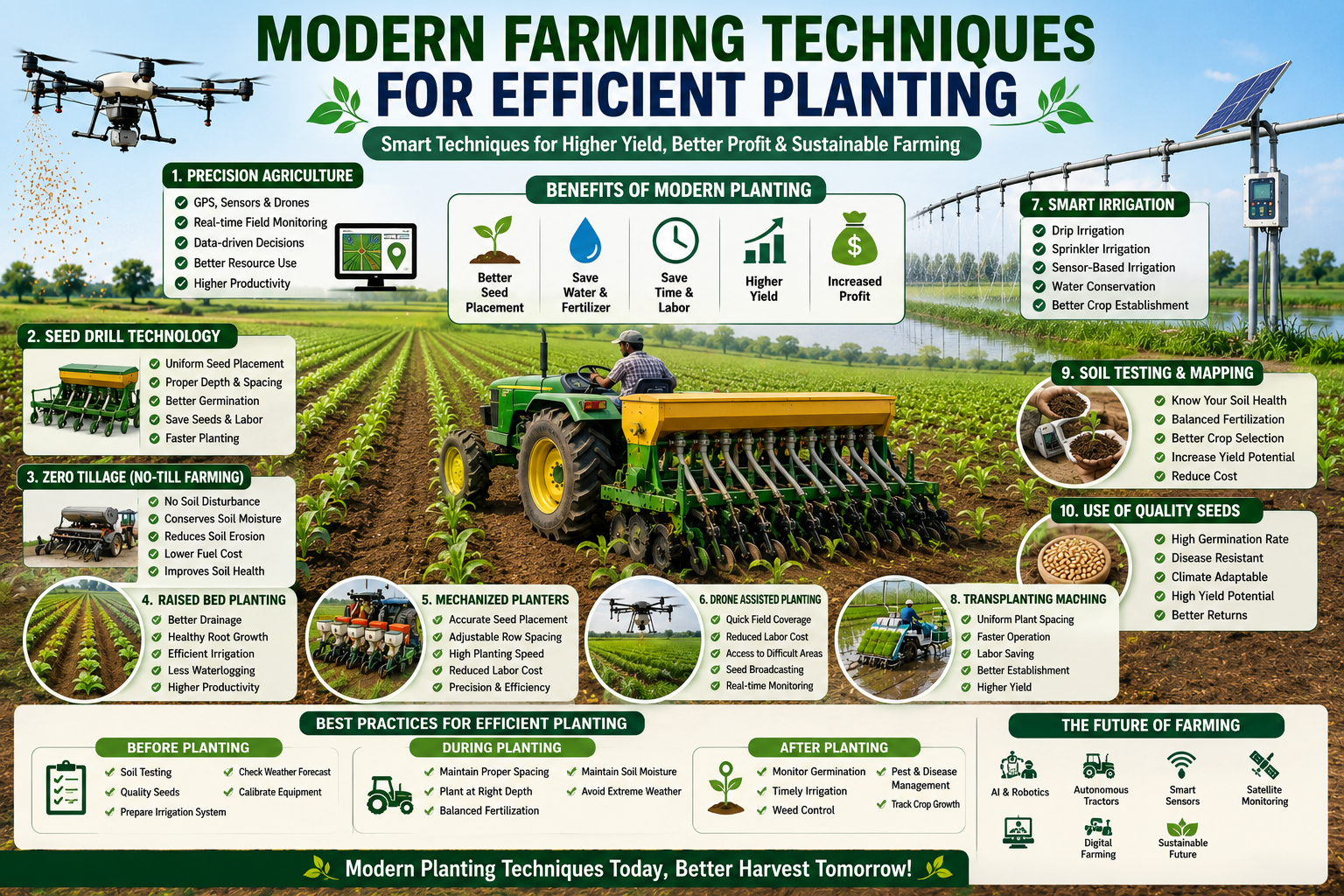
Modern Farming Techniques for Efficient Planting
1. Precision Agriculture
Precision agriculture uses GPS, sensors, drones, and data analytics to improve farming decisions.
Benefits:
- Accurate seed placement
- Reduced input costs
- Better field monitoring
- Increased productivity
- Improved resource efficiency
Farmers can identify variations within fields and plant according to soil conditions and moisture levels.
2. Seed Drilling Technology
Seed drills place seeds at the correct depth and spacing.
Advantages:
- Uniform seed distribution
- Better seed-to-soil contact
- Reduced seed wastage
- Faster planting operations
- Improved germination
This technique is widely used for wheat, maize, soybean, and pulses.
3. Zero Tillage (No-Till Farming)
Zero tillage involves planting crops without disturbing the soil through plowing.
Benefits:
- Conserves soil moisture
- Reduces soil erosion
- Lowers fuel costs
- Improves soil health
- Enhances organic matter
This method is becoming increasingly popular among sustainable farmers.
4. Raised Bed Planting
In this system, crops are planted on raised soil beds.
Advantages:
- Better drainage
- Improved root development
- Efficient irrigation
- Reduced waterlogging
- Higher crop productivity
Raised bed planting is suitable for vegetables, maize, wheat, and cotton.
5. Mechanized Planters
Modern planters use advanced machinery for accurate seed placement.
Key Features:
- Adjustable row spacing
- Uniform seed depth
- High planting speed
- Reduced labor requirement
- Precision fertilizer application
Mechanized planters are ideal for large-scale farming operations.
6. Drone-Assisted Planting
Agricultural drones are increasingly used for seed broadcasting and field monitoring.
Benefits:
- Quick field coverage
- Reduced labor costs
- Access to difficult terrains
- Improved planting efficiency
- Real-time crop monitoring
Drone technology is revolutionizing modern agriculture.
7. Smart Irrigation Systems
Efficient planting requires proper water management.
Types:
- Drip Irrigation
- Sprinkler Irrigation
- Sensor-Based Irrigation
Benefits:
- Water conservation
- Better crop establishment
- Reduced water wastage
- Improved plant growth
Combining smart irrigation with precision planting maximizes yields.
8. Transplanting Machines
These machines are commonly used in rice and vegetable cultivation.
Advantages:
- Uniform plant spacing
- Faster operations
- Reduced labor costs
- Better plant establishment
- Increased productivity
Mechanized transplanting saves significant time during peak planting seasons.
9. Soil Testing and Mapping
Understanding soil conditions before planting is crucial.
Benefits:
- Proper nutrient management
- Better fertilizer recommendations
- Improved crop selection
- Higher yield potential
- Reduced production costs
Regular soil testing helps farmers make informed decisions.
10. Use of High-Quality Seeds
Modern farming begins with quality seeds.
Characteristics:
- High germination rate
- Disease resistance
- Climate adaptability
- Improved yield potential
Certified seeds provide better returns on investment.
Best Practices for Efficient Planting
Before Planting
1. Conduct soil testing
2. Select suitable crop varieties
3. Prepare irrigation systems
4. Ensure seed quality
5. Calibrate planting equipment
During Planting
1. Maintain proper spacing
2. Plant at recommended depth
3. Apply balanced fertilizers
4. Monitor soil moisture
5. Avoid planting in extreme weather
After Planting
1. Monitor germination
2. Control weeds early
3. Manage pests and diseases
4. Ensure timely irrigation
5. Track crop growth regularly
Challenges in Adopting Modern Planting Techniques
Some farmers face challenges such as:
- High initial investment
- Lack of technical knowledge
- Limited access to machinery
- Inadequate training
- Small land holdings
However, government subsidies, agricultural extension services, and farmer training programs are helping overcome these barriers.
Future of Efficient Planting in Agriculture
The future of planting technology includes:
- Artificial Intelligence (AI)
- Robotics in agriculture
- Autonomous tractors
- Smart sensors
- Satellite-based monitoring
- Climate-smart farming systems
These innovations will help farmers produce more food using fewer resources.
Conclusion
Modern farming techniques for efficient planting are transforming agriculture by increasing productivity, reducing costs, and improving sustainability. Technologies such as precision agriculture, seed drilling, drone planting, smart irrigation, and mechanized planters enable farmers to optimize every stage of crop establishment.
Farmers who adopt these modern planting methods can achieve higher yields, better resource utilization, and improved profitability while ensuring long-term agricultural sustainability.